


Key Takeaways:
- In Georgia, Katie Beckett eligibility depends more on proving a child’s day-to-day support needs meet an institutional level of care standard than on having an autism diagnosis alone.
- The paperwork that carries the most weight shows specific functional limitations across home, school, and community, and individualized BCBA-led assessment can help families translate daily challenges into documentation that reviewers can actually use.
- Katie Beckett approval can open the door to Medicaid-covered ABA, but therapy does not start automatically, so families move faster when they begin provider intake and care planning while waiver questions are still being resolved.
Many families who look into the Katie Beckett waiver for autism in Georgia start with the wrong question. They ask, “Does my child qualify?” when the more useful question is, “Can I clearly show how my child’s autism affects their daily life?” Eligibility under Georgia’s TEFRA/Katie Beckett program hinges far less on a diagnosis label and far more on whether a child’s support needs meet an institutional level of care standard — something families can actually build a case for, with the right guidance.
That case is built from specifics: records that demonstrate functional need, daily observations that reveal how autism shapes every routine, and clinical assessments that connect a child’s challenges to the support they require. Apollo Behavior’s Board Certified Behavior Analysts (BCBAs) work alongside families to build exactly that picture, maintaining small caseloads so they can observe each child closely across settings and document what a summary report alone cannot.
Who Qualifies in Georgia
The Katie Beckett Deeming Waiver in Georgia is not a diagnosis checklist; it is a daily life checklist. What matters to reviewers is not which label a child carries, but how that label plays out across meals, mornings, transitions, and moments of distress. The questions below address what families typically want to know before they start gathering records or reaching out to their child’s care team.
How do I qualify for the Katie Beckett Deeming Waiver in Georgia for autism?
Georgia’s TEFRA/Katie Beckett program bases eligibility on whether a child needs an institutional level of care, not simply whether they have a diagnosis. A child with autism may qualify when their support needs, across daily routines, communication, behavior, or safety, are significant enough to meet that standard. The child must be under 18 and living at home.
What do Georgia eligibility requirements ask families to show beyond an autism diagnosis?
A diagnosis opens the conversation, but it does not close the case. Families typically need to demonstrate functional limitations — real, day-to-day situations where the child requires assistance or supervision that most children their age do not. Clinical evaluations, caregiver observations, and therapy records all help build that picture.
Does a child have to need nursing-home-level care to qualify?
The standard is tied to the type of care a facility would provide, not the setting itself. A child with autism whose needs are complex enough that they would otherwise require institutional care can qualify, even while living at home. Well-documented daily support needs often satisfy this threshold when described clearly and specifically.
Does family income affect eligibility under the Katie Beckett pathway?
This is one of the program’s most important features. Under the Katie Beckett deeming process, parental income is not counted when determining a child’s Medicaid eligibility. The child is evaluated based on their own financial situation, which means many families who earn too much for traditional Medicaid can still access coverage for their child.
Can a preschool-aged child with autism qualify, and what needs matter most at that age?
Yes. Age is not a barrier as long as the child is under 18. For preschool-aged children, reviewers look at how autism affects communication, self-care, and the ability to participate safely in daily activities. Families can begin the process by submitting a Form 94 application and gathering records from their child’s pediatrician, evaluating psychologist, or therapy team.
What Documentation Matters Most
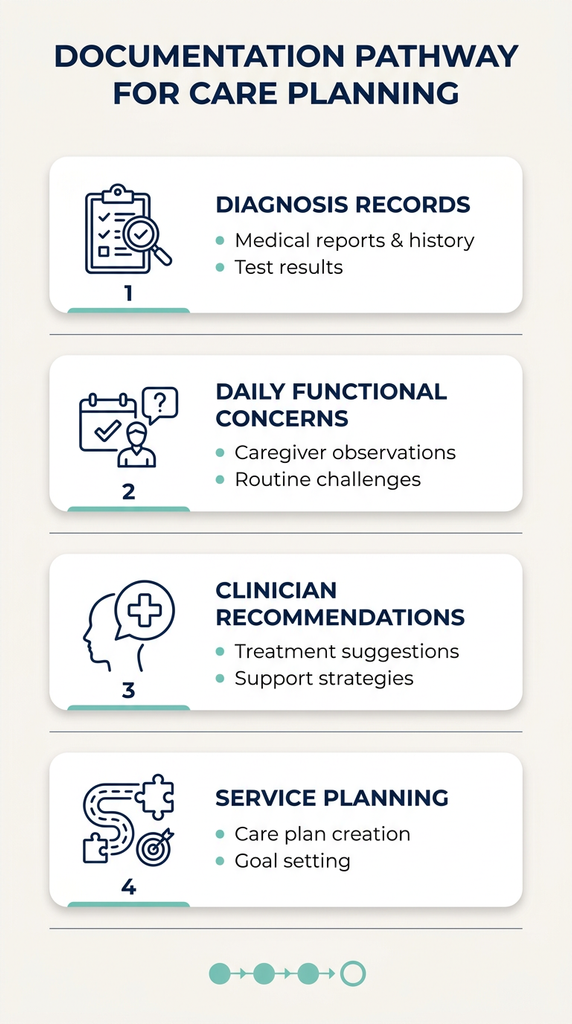
Once a family understands the eligibility standard, the next challenge is showing it on paper. The records you submit need to tell a reviewer exactly how your child’s autism shapes their daily life — not just confirm that a diagnosis exists.
What is autism-related functional limitations documentation, and how should families describe it?
Autism-related functional limitations documentation captures the real ways a child needs help that peers their age typically do not. Think specifics: how your child communicates needs, what happens during transitions, how they respond in unfamiliar or unsafe situations. Concrete examples across settings carry far more weight than general statements.
Which records usually strengthen an application most?
No single document wins the case alone. Diagnostic evaluations, pediatrician statements, therapy notes, school reports, and caregiver observations each add a different angle. Together, they show a consistent pattern of support needs across home, school, and community — which is exactly what reviewers look for.
What does medical necessity paperwork for autism services need to explain?
Medical necessity paperwork should connect the dots between a child’s diagnosis and the specific help they require day to day. It is not enough to name a condition. The documentation needs to explain why certain supports are needed, how often, and what happens without them. Vague clinical language rarely satisfies that standard.
How can families avoid submitting labels without showing real need?
The most common documentation gap is listing diagnoses and scores without describing what those numbers mean at home or school. A record that says “significant communication delay” matters less than one that explains your child cannot signal pain, hunger, or fear reliably. Specific, observable descriptions of daily challenges make the case far more clearly.
How can a Board Certified Behavior Analyst’s assessment help with care planning documentation?
A BCBA’s direct observation and individualized assessment captures exactly the kind of setting-specific, functional evidence that strengthens a child’s profile for care planning. Because Apollo Behavior’s BCBAs maintain small caseloads, they develop a detailed, accurate picture of how each child functions across environments — the kind of personalized clinical documentation that goes well beyond a diagnosis summary.
How the Waiver Connects to ABA Care
Katie Beckett approval establishes Georgia Medicaid eligibility for your child, but it does not automatically start services. The questions below explain what that approval unlocks, what still requires a separate authorization step, and how to get a child into ABA care as quickly as possible.
Does ABA therapy coverage through the Katie Beckett Waiver start automatically once a child is approved?
Not quite. Katie Beckett approval establishes Georgia Medicaid eligibility for your child, which is a significant door opening. From there, accessing ABA specifically still involves a provider intake, a clinical assessment, and an authorization process. Medicaid covers the services; the provider and payer coordinate the authorization together.
Which autism services may still need a separate medical necessity review?
Even with Medicaid access established, Georgia Medicaid’s ASD services require that the clinical need for specific treatments be documented and reviewed. ABA therapy is one of those services. A BCBA-led assessment that describes your child’s functional needs, recommended therapy hours, and individualized goals is what supports that review.
What should families ask an ABA provider before starting care?
Ask how the provider conducts their initial assessment, how therapy hours are determined, and how goals are built around your child’s specific daily needs. Understanding ABA provider questions before you begin helps families feel prepared and ensures the program is genuinely built around their child, not a generic template.
Why reach out to a provider now, even before waiver questions are fully resolved?
Waiting for every piece to fall into place before making contact can add months to your child’s start date. Provider intake processes often run alongside insurance and waiver reviews. Starting that conversation early means your child can begin care sooner once authorization is in place.
Take the Next Step With Apollo Behavior
Katie Beckett eligibility in Georgia is really about one thing: showing, clearly and specifically, how your child’s autism affects their daily life. The application process asks families to document real support needs across communication, behavior, safety, and routines, not just hand over a diagnosis. When that picture is drawn well, it opens doors to Medicaid-covered services your child may genuinely need.
Apollo Behavior’s Board Certified Behavior Analysts do exactly this kind of work every session: observing each child closely, documenting real functional needs, and building individualized, play-based programs around those specifics. That same precision in capturing how a child actually functions is part of why more than 75% of Apollo’s graduating clients are placed in general education settings, with early intervention clients approaching 90%, and why graduating clients average 18 months of therapy compared to 30 or more months at other providers. Apollo also accepts major insurance carriers, including Anthem and Humana. Whether the waiver process is just beginning or already underway, a conversation with Apollo’s care team is a concrete next step toward getting your child the support they need.