


Key Takeaways:
- Scoring the M-CHAT R/F at home is manageable when parents answer from everyday behavior, count only failed responses correctly, and double-check reverse-scored items that can change the result.
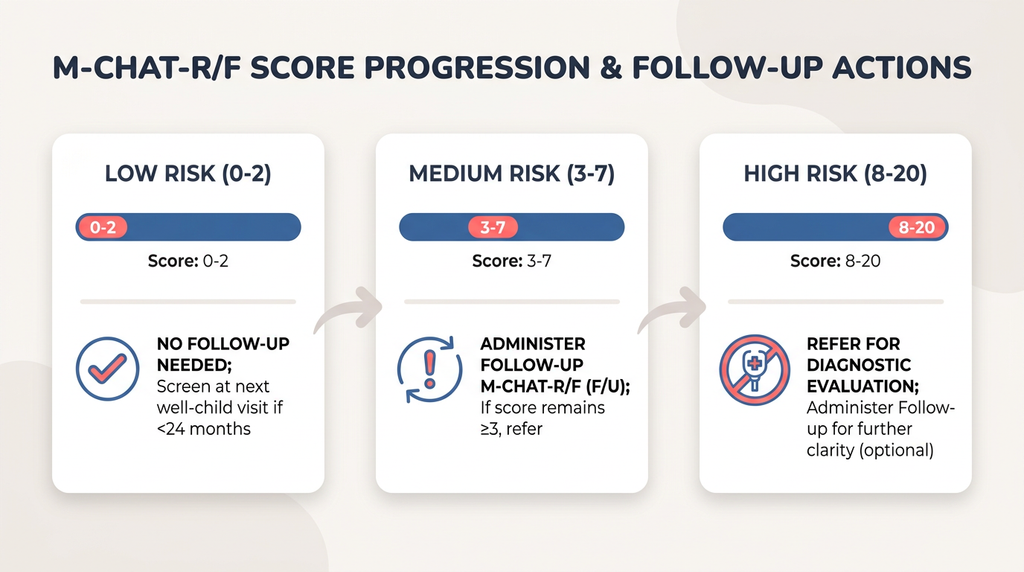
- An M-CHAT R/F score gives direction, not a diagnosis: 0 to 2 usually means keep monitoring, 3 to 7 calls for the follow-up interview, and 8 to 20 means it is time to move quickly toward evaluation.
- Parents should not wait for perfect certainty to act; if concerns persist, bring the score and your observations to the pediatrician and start exploring individualized support early.
Getting an M-CHAT R/F result without context puts parents in an impossible position: act on a number they don’t understand, or wait on a concern they can’t shake. The M-CHAT R/F-R/F is a screening tool, not a diagnosis, and its score only becomes useful when you understand what it’s routing you toward. With a clear M-CHAT R/F scoring guide for parents, that number stops feeling like a verdict and becomes a concrete next step.
How to Score the M-CHAT R/F at Home
Scoring the M-CHAT R/F at home means going through each of the 20 questions, marking whether each response matches that item’s failed pattern, and totaling the failed items. The details matter: official scoring guidance shows that certain items score in reverse, so a “yes” answer can count as a failed response depending on the question. If you’d rather skip the manual count, Autism Speaks offers a virtual M-CHAT-R/F that scores your answers for you and suggests next steps.
Answer Based on What Your Child Usually Does
Before counting anything, answer each question based on your child’s typical, everyday behavior. Not their best moment at a birthday party, and not a rough day either. If a behavior happens sometimes but not consistently, the answer is generally “no.” This keeps the result grounded in what’s actually going on day to day.
Count Only the Responses That Count as “Failed”
The M-CHAT-R/F printable has 20 items, and each one has a specific response pattern that counts as a failed item. Some questions fail on “no,” others fail on “yes.” Go through each item and mark whether it falls in the failed pattern, then add up your total. That number is your score.
One Item Can Shift the Follow-Up Recommendation
Careful scoring matters more than most parents expect. Because score ranges have defined cut-off points, a single miscounted item can move a result from one follow-up category to another. Taking a few extra minutes to re-read each item before marking it reduces the chance of acting on a number that doesn’t reflect your child accurately.
What Different M-CHAT R/F Scores Mean
Once you have your total count of failed items, the score falls into one of three ranges, each pointing to a different next step. The official M-CHAT-R/F scoring guidance defines those ranges clearly, and understanding what each one means can replace a lot of the anxiety that comes with not knowing what to do next.
- Score of 0–2 (low risk): A low score points to less concern, and in most cases no follow-up is needed before the next scheduled screening. That said, a low score does not erase a worry you or your child’s pediatrician already has. If something still feels off about your child’s communication, play, or social engagement, those observations still matter and deserve a conversation with your doctor.
- Score of 3–7 (medium risk): This is where the M-CHAT-R/F Follow-Up interview becomes important. The follow-up is a short set of clarifying questions that a provider uses to confirm whether the original responses reflect your child’s typical behavior. A published study found that this second stage can meaningfully change how a mid-range score is interpreted, which is exactly why skipping it would leave families with an incomplete picture.
- Score of 8–20 (high risk): A higher score signals that prompt follow-up is the right move, not because a score diagnoses anything, but because the CDC recommends moving quickly toward evaluation when screening indicates elevated concern. Early action gives families more time to access support, and more time in support tends to produce better outcomes.
Across all three ranges, keep one thing in mind: the M-CHAT R/F does not deliver a diagnosis. As Apollo Behavior’s autism overview explains, a formal diagnosis requires a separate, comprehensive evaluation. What a score gives you is direction: a clear signal about whether to keep monitoring, schedule a follow-up interview, or reach out for evaluation now.
Common Parent Questions After an M-CHAT R/F Score
A score on a screening tool rarely answers every question parents have; it usually opens new ones. Below are the questions families ask most, with direct answers so you know exactly where to go from here.
What should I do after an M-CHAT R/F result suggests autism risk?
Start by sharing the result with your child’s pediatrician, nurse practitioner, or other medical provider. They can refer you for a comprehensive empirically supported psychological evaluation, which goes beyond the screen to look at your child’s communication, play, and social development in depth. The M-CHAT R/F can identify potentially concerning behaviors, but a comprehensive empirically supported psychological evaluation helps identify why those behaviors are occurring and whether they truly warrant further support. Bringing a record of specific behaviors you’ve noticed at home helps that conversation go further.
Does a low score mean I should stop paying attention to speech, play, or social concerns?
No. A low score reflects what the screen captured on one day. Research on the M-CHAT R/F recommends continued developmental surveillance even for children who score in the lower-risk range. If a concern persists, trust it and bring it back up at the next well-child visit.
If the score is concerning, should I wait for a formal diagnosis before asking about ABA support?
You do not need to wait. A formal diagnosis is not required to begin learning about your options or to start the intake process with a provider. If your child is between the ages of 0 and 2, you can begin receiving services through Babies Can’t Wait, a state program available to any child showing potential concerns, and it does not require a formal evaluation. Children ages 3 and older are eligible for services through the public school system, which also does not require a formal diagnosis, though the school will conduct its own separate evaluation. Early support can begin during the evaluation period, and acting sooner tends to produce faster progress than waiting for paperwork to catch up.
Can the M-CHAT R/F miss something even if my child has real developmental differences?
Yes, it can. No screening tool is perfect, and the M-CHAT R/F is designed to flag risk, not to catch every child who may benefit from support. If your observations at home don’t match a low score, Apollo Behavior’s early signs guide can help you document what you’re seeing and bring clearer information to your pediatrician.
Turn an M-CHAT R/F Result Into the Right Next Step
A score on its own only tells part of the story. Research published in Pediatrics confirms that M-CHAT R/F next steps for parents should always include pairing the screen result with a child’s developmental history and professional evaluation, not treating a number as a final answer. Screening is where the process starts, not where it ends.
What moves a family forward is knowing what to do with the result. Apollo Behavior’s Center-Based ABA Therapy is built around exactly that: one-on-one sessions and play-based learning guided by Board Certified Behavior Analysts who maintain small caseloads, so your child’s program reflects who they actually are, not a standard template. Graduating clients average 18 months of therapy compared to 30 or more months at other providers, and over 75% go on to general education settings. A score that points toward support is only as useful as the support that follows it.
If your child’s score has you wondering what comes next, you do not have to figure it out alone.